

People with a clear diction by nature are extremely rare. But, do not believe that diction cannot be improved. Each of us can improve its pronunciation. You can put the right diction not only in childhood, but also in an adult. We will talk about special techniques and techniques in this article.
The content of the article
- What is speech diction?
- Is it necessary to read aloud for the development of diction?
- How to improve diction to an adult, a teenager?
- Warm up for diction
- Work on diction and pronunciation
- Exercises for diction and voice
- Exercises for diction and articulation
- Tensions for the development of diction
- How to improve diction? Tips and reviews
- Video. Exercise for diction, which will make your speech beautiful in a week
What is speech diction?
Diction is a clear pronunciation of sounds and words. A clear and beautiful speech positively affects the perception of the person who has it. Therefore, not only the announcer of central television, but also each of us should have a clear and intelligible diction.
If you want to not just speak, but make your interlocutors understand you, you need to work on your diction. Especially if she needs it.
What is the diction:
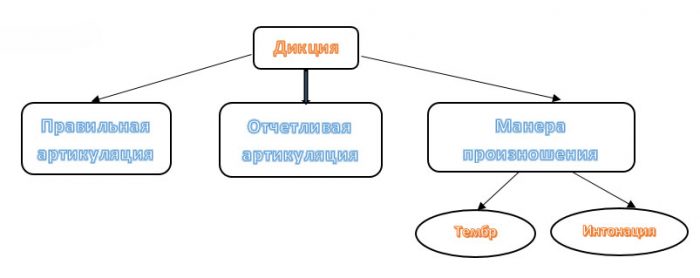
Calm articulation (Correct and clear pronunciation of sounds). It is thanks to clear articulation that the speaker’s speech is legible and his interlocutors easily understand what he wants to convey. Violation of this indicator of diction may occur due to the physiological characteristics of a person. You can improve the clarity of pronunciation of sounds using the training of the language and the muscles of the lips.
Proper articulation (Agreed movement of the muscles of the articulation apparatus). Negatively affect the articulation of a bite violation, bridle, etc. With such physiological deviations, burdens, nasal can appear.
Timbre. Often, the person’s temperament affects the pronunciation manner. The speaker can be inclined to monotony or accelerate his speech. Often, it is haste that people with poor diction are found. But, as practice shows, almost any person can “defeat” this problem.
Intonation. As for intonation, it is formed primarily from the ability to clearly pronounce vowels and stresses. You can put intonation using some breathing exercises and reading aloud. Improving intonation is a very difficult and painstaking work.
Is it necessary to read aloud for the development of diction?

Reading aloud
Each speech therapist will tell you that one of the best exercises for diction is reading aloud. At the same time, it is important not the number of words read, but the articulation and clarity of the pronunciation of sounds.
When using this technique, one should not forget that reading has other useful qualities. A pleasant “bonus” of such a technique of improving diction will be an increase in vocabulary, improving imagination, and the development of memory.
Many people like to read, and at the same time their diction leaves much to be desired. That is why, you need to read aloud. Try to clearly and with the expression to pronounce letters and words written in books, color your speech in emotional colors.
Regular reading aloud will help get rid of tongue -tied tongue, reservations, seamstresses and other things that negatively affect diction.
Since the text of books, especially in classical literature, is very different from how we talk in everyday life, will help you not only to express yourself beautifully, but also to form your speech according to the literary language.
Reading aloud, do not rush. Sit in a comfortable chair and take a book. It is desirable that it be one of your favorite books. Of course, militants or Russian “detectives” are not suitable for such practice. Complex scientific literature too.
A very beautiful syllable at Lev Nikolayevich Tolstoy. But, in his main work “War and Peace” is too much French. Therefore, this work will not suit you. Practice on his earlier stories.
Soviet fiction is suitable for reading aloud. Especially the works of the Strugatsky brothers. Unfortunately, their modern followers have simplified the genre too much and are unlikely to be suitable for reading aloud.
Read the selected work expressively, denoting stresses and making the necessary pauses. If you return to the Strugatsky, then listen to the audio books of these authors recorded by Vladimir Levashov. Take his diction by the standard and try to repeat.
You can go further and add a little artistry to your reading aloud. Try to present the heroes of the work, their appearance and character. Then bring individual notes to their replicas. But, of course, do not forget about the most important thing - diction training. It is not worth overdoing with artistry.
When you begin to read aloud confidently, you can slightly increase the speed of reading. But, it is important to clearly and clearly pronounce sounds and words. With an increase in reading speed, monotony cannot be lost and excessive acceleration. Even if on the next page of the book you find out the interchange of the event.
In order for reading aloud to give an effect, it is important to read at least 30 minutes a day. And in a month you can achieve noticeable success. And in order to be sure that your diction is progressing, write down on the recorder the way you began to read aloud and how you read such regular training after a while.
How to improve diction to an adult, a teenager?
The king says!
WALNUTS. A good way to improve your diction is to use walnuts for this. They need to be laid behind the cheek (one on each side) and pronounced a tongue twister within a few minutes. After that, it is necessary to extract nuts and again say the same tongue twister.
Pencil in the teeth. Click your pencil with your teeth and read some poem from memory with the expression.
Important: both techniques can be applied to both children and adults. With their regular use, you can improve diction, make speech more liberated and free. Such a technique can be used even in cases of speech impairment as a result of a stroke.
Record on the recorder. This technique can be combined with reading aloud, which we talked about above. Turn on the recorder before reading aloud and write down a fragment of any text you read. Then you need to listen to the record and note the sounds that you say incorrectly. When reading books subsequently, try to pay special attention to problematic sounds aloud.
TONGUE TWISTERS. Perhaps the most famous way to improve their diction is tongue twisters. Repeat these rhythmic phrases daily. Pay special attention to pronouncing problematic sounds. If your diction suffers from incorrectly pronounced hissing or whistling sounds, then this problem can be solved with the help of a tongue twister:

Articuliation gymnastics. There are many exercises to improve diction, which are included in the concept of articulation gymnastics. With their help, you can significantly improve the pronunciation in an adult. We will talk about them in the section "Exercises for diction and articulation."
BREATHING EXERCISES. Many underestimate the correct posture and breathing during communication with other people. But, without this, it is impossible to have the right diction. The correct breaths and exhalations are devoted to whole courses in the study of acting. And if you want to talk like Andrei Mironov or Vasily Livanov, then be sure to give your breathing training a few minutes a day.
- Stand straight, put your arms on the belt, and legs shoulder -width apart
- Make a slow breath through slightly ajar lips
- Then also try to inhale the air reading the text aloud
- Then complicate the task even more: move around the room, take a breath and say
- When you exhale, rise and pull the letter "mmm"
Warm up for diction

Pencil in the teeth - an excellent exercise for diction
Before public speaking, it is necessary to warm up the diction. To do this, you can use the methods described above. For example, take a pencil in the teeth and read a few tongue twisters. Then you need to pronounce the same thing without a pencil.
Try to utter complex words from the text that you need to convey to the listeners several times. Read your favorite poem from memory. Several minutes of such a warm -up is enough to stretch your vocal cords, facial muscles and set yourself up for performance.
You can also extend diction using the following exercises:
| Stick and hide | We put forward the tongue forward as far as possible, then hide it back. We move the tongue forward, and then back. Exercise duration-2-4 minutes |
| Postering the cheeks with the tongue | We begin to stab our cheeks in turn. First, the left cheek, then the right. Exercise duration 3-5 minutes |
| "Teeth cleaning" | We rotate the tongue in the mouth in a circle. The mouth should be closed. We make 15-20 rotations clockwise and vice versa |
| Circular movements | We pull the tongue and twist them in a circle. Make 10-15 circles clockwise, then against |
| "Pipe is a smile" | We pull the lips forward, after 3 seconds you begin to smile as wide as possible. First lips forward, then back. We do this exercise for at least 3 minutes. |
| "Bubble" | We puff up one cheek, then the other. Duration 2 minutes |
Work on diction and pronunciation
Oratory talent is extremely rare. Almost all famous people are intensely preparing for every public performance. It is known that Cicero could not pronounce a single word without preparation. And he is still set as an example as a great rhetoric.
There are a lot of exercises with which your speech can become clear and beautiful. There are as universal exercises, those that are designed to help correct a specific problem. For example, a whistling “C”, slurred “l” or violations in the pronunciation of the sound “P”. In order to solve these problems, you will have to work.
Exercises for diction and voice

Diction
During a public performance or in a normal conversation, we use the muscles of the tongue and pharynx. It is logical that in order to speak beautifully you need to "pump" these muscles. But, unlike biceps and pectoral muscles, we will not need sports shells.
1.Pumping muscles involved in the reproduction of sounds can be regularly pronouncing "Ahh". At the same time, it is important to try to open your mouth not very much. The effect can be achieved if you pronounce sounds deeper in the oral cavity as possible.
2.A very good effect can be achieved in diction and training lips. To do this, you need to say:
- "GL", "VL", "VN" - For the upper lip
- "KS", "GZ", "ZA", "BZ" - For the lower lip
3.You can also give the tongue the shape of a shovel and pronounce "AND" And "E" repeatedly. Now let the tongue give the shape of the hook and at the same time say "ABOUT" And "U".
4.We continue to “pump” the muscles of the tongue. Close our mouths and with the help of internal movements of the sky, cheeks and lips we pull the sound "M".
Performing these exercises for diction, you can feel the result after a few regular classes.
Exercises for diction and articulation

Articulation
Since in clear pronunciation the tip of the tongue is very actively “working”, there are several exercises that will help improve its activity.
1.Imagine that your tongue is a hammer and beat it with the tip of your teeth. During such blows, “say” yes-yes-yes-yes. Then try to clearly say the letters "T-D".
2.For a clear pronunciation of letters "TO" And "G" You need to "pump" your larynx. To do this, take a breath and completely free the lungs through the mouth. The release of air with the mouth should occur sharply and resemble the sound "Ugh". Carry out such an exercise several times.
3.If you notice a problem when pronouncing letters "P" And "B", then train your labial muscles. To do this, inflate the cheeks and release the air from the mouth with energetic cotton.
4.It is also very important to learn how to control the amount of air. To do this, use breathing exercises and practice in front of the mirror. Try to read a small text with normal volume. As a rule, at the same time you can easily control your voice. Now, do the same, but increasing the volume. There will be problems.
With regular declaration of text with increased volume, you will soon be able to control the amount of air and you can successfully speak to a large audience.
5.There is another exercise to improve articulation. Take a few lines from your favorite poem. Then exclude consonants from these lines and soak only vowels. Then insert the consonants and make them loudly without changing the pronunciation of the vowels.
Also, articulation can be improved with the help of such exercises:
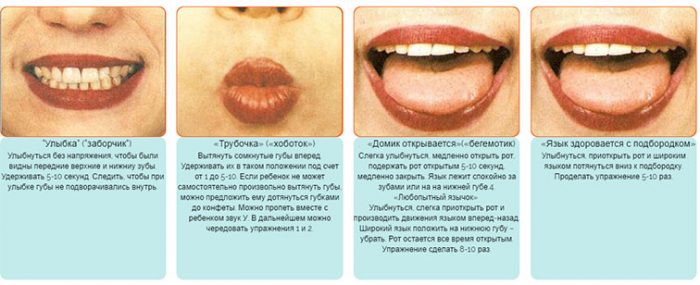
diction

diction
If you notice a swallowing end of the words, then read any text, emphasizing the end of the words written in it. This must be done daily, and after a while it will be possible to forget about such a problem of your diction.
With a problem with the pronunciation of any separate letter, take the explanatory dictionary of the Russian language and clearly read all the words with this letter. Do it regularly. If desired, write this exercise on the recorder.
Tensions for the development of diction

Tongue Twisters
The most popular way to improve their diction are tongue twisters. They can be used as a warm -up before a public performance. In general, make yourself a habit of pronounce a few speed -twisters daily. Such a training will help you overcome the problems in the pronunciation of some sounds and make speech more convincing and beautiful.
For such a training, you do not need to allocate time. You can repeat the tongue twisters while gathering for work. Experts believe that three weeks of use of speed risk will make a speech smooth, and a clear diction.
Here, the most popular tongue twisters that will help improve diction:
For training sounds: r, l, m, n

diction
For training sounds: b, p, c, f, g, k, d, t, x
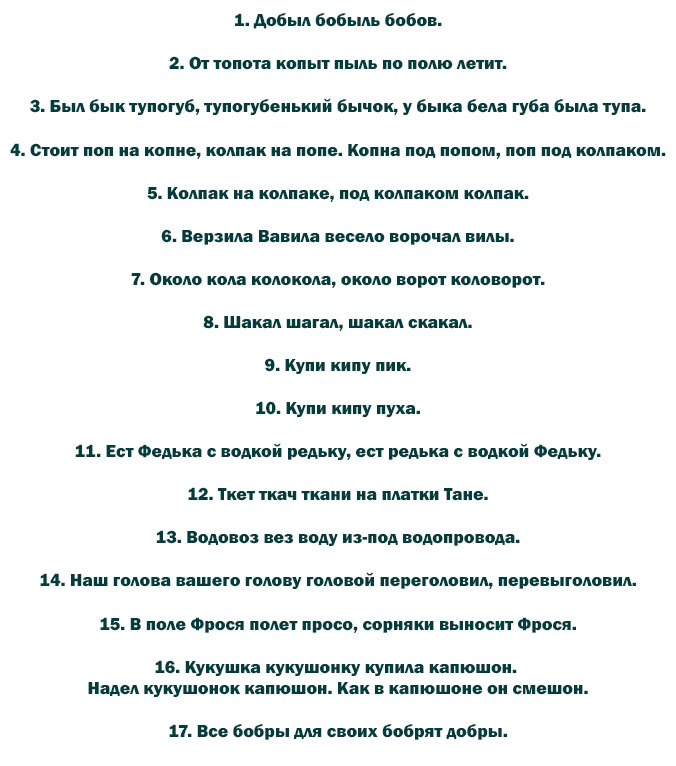
diction
For training sounds: S, h, w, w, w, h, s, c.
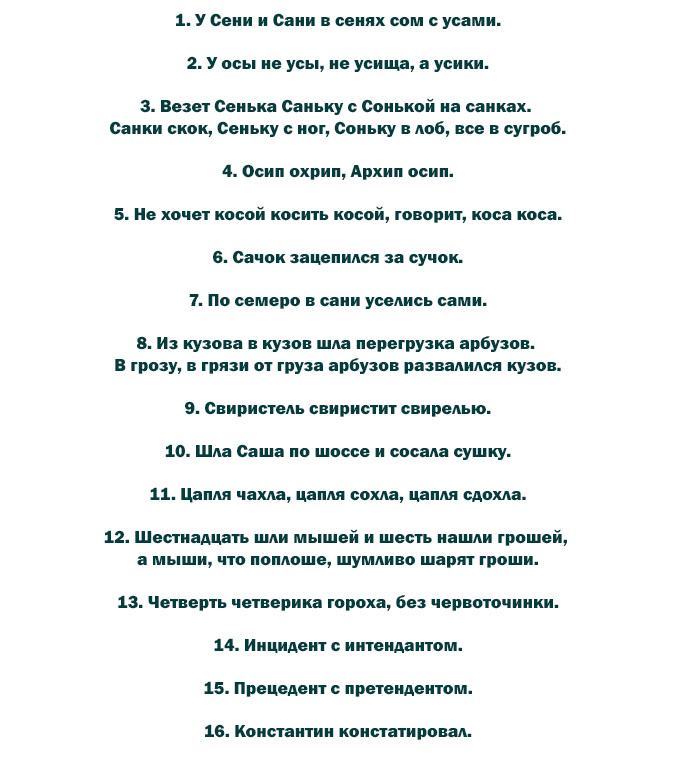
diction
How to improve diction? Tips and reviews
Christina. I am from the south of Russia earlier often Ghakala. When she studied in St. Petersburg, she was very shy. I looked on the Internet and found a simple way to get rid of this speech defect. You just need to pronounce phrases containing the sound "Ge". It is necessary to focus on this sound and clearly pronounce it. Two weeks later, I began to pronounce this sound correctly and forgot about this problem.
Yuri. Back in his student years, he participated in a drama circle. Our leader tactfully hinted that I have not the best diction. And she asked, at least 30 minutes a day to read books aloud. I liked this exercise so much that I began to devote even more time to him. And the diction has become noticeably better.